Small mechanism. Remarkable control.
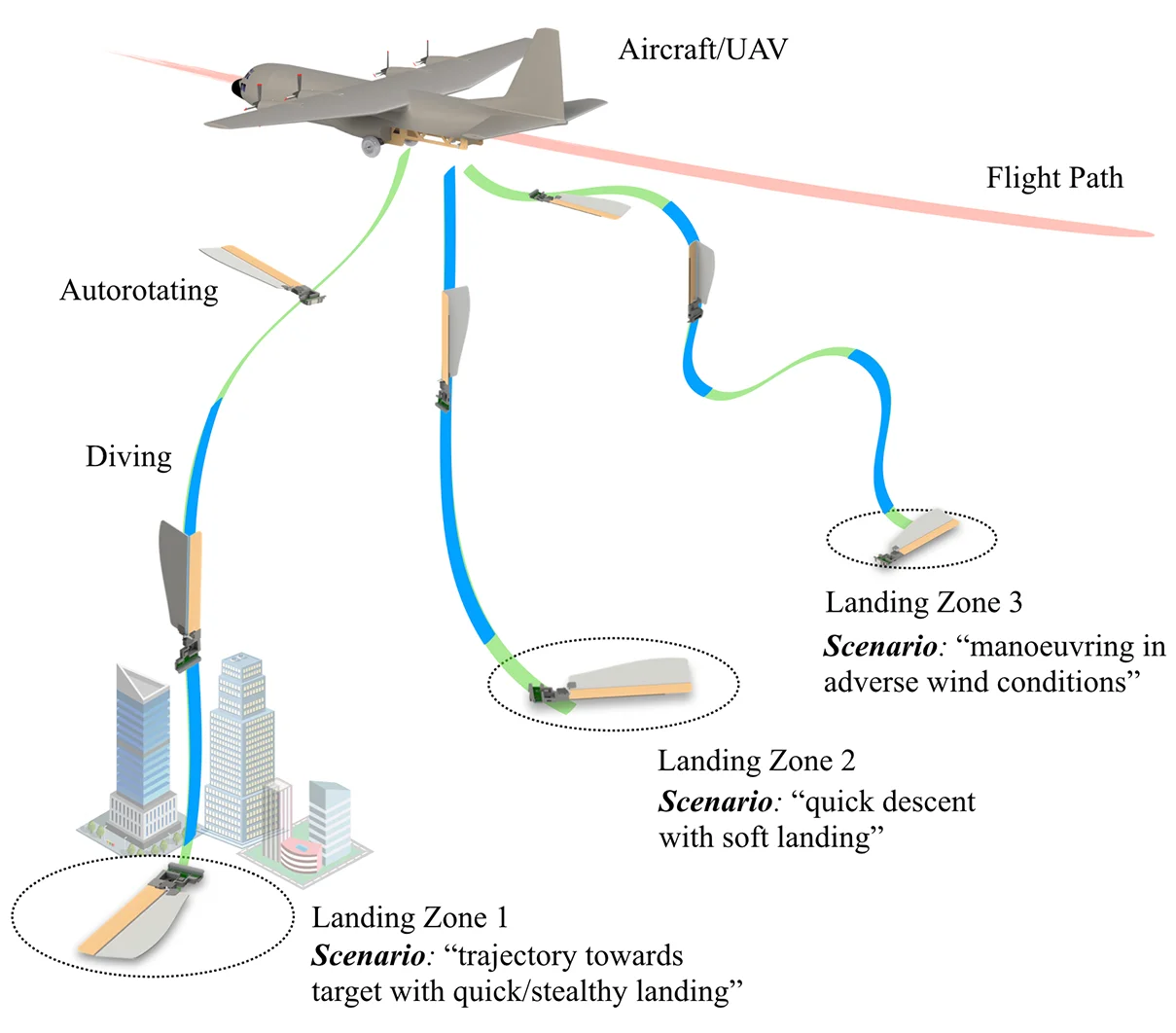
A maple seed’s descent is naturally stable. Agile Samara Glider dSAW adds control: a single flap steers the robot as it autorotates, switches it into a fast dive, and recovers it into a slower descent.
Designed for deploying lightweight sensors, the diving Samara Autorotating Wing uses gravity for flight rather than onboard propulsion. Wing geometry and cyclic flap control were optimised together using a six-degree-of-freedom blade-element model and a genetic algorithm.
Key results
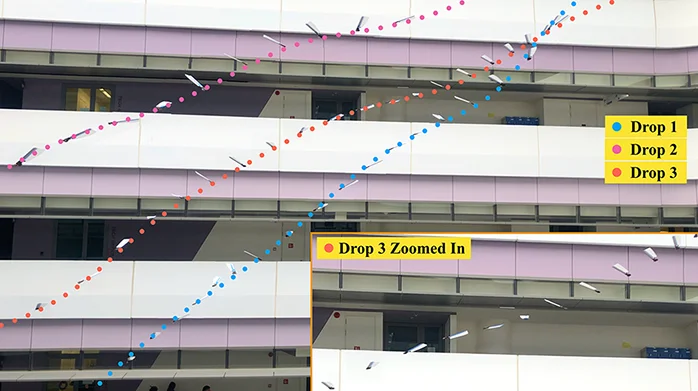
- An average glide angle of 28.9° corresponds to 1.81 m of lateral travel for every metre of altitude lost.
- The prototype autorotated at a descent speed of 1.43 m/s and a rotation rate of 4.17 Hz.
- Diving increased descent speed by at least 17.6 times, with bidirectional transitions controlled by the same single actuator.
- Semi-outdoor experiments validated gliding and transitions; outdoor drops from a fixed-wing UAV demonstrated an aerial deployment scenario.
See it in action
Watch on YouTube ↗Results are reported in “An Agile Samara-Inspired Single-Actuator Aerial Robot Capable of Autorotation and Diving,” DOI: 10.1109/TRO.2021.3091275. Published online in 2021; volume 38, issue 2, pages 1033–1046.